
What Is a Payment Gateway? A Complete Guide for Global Businesses
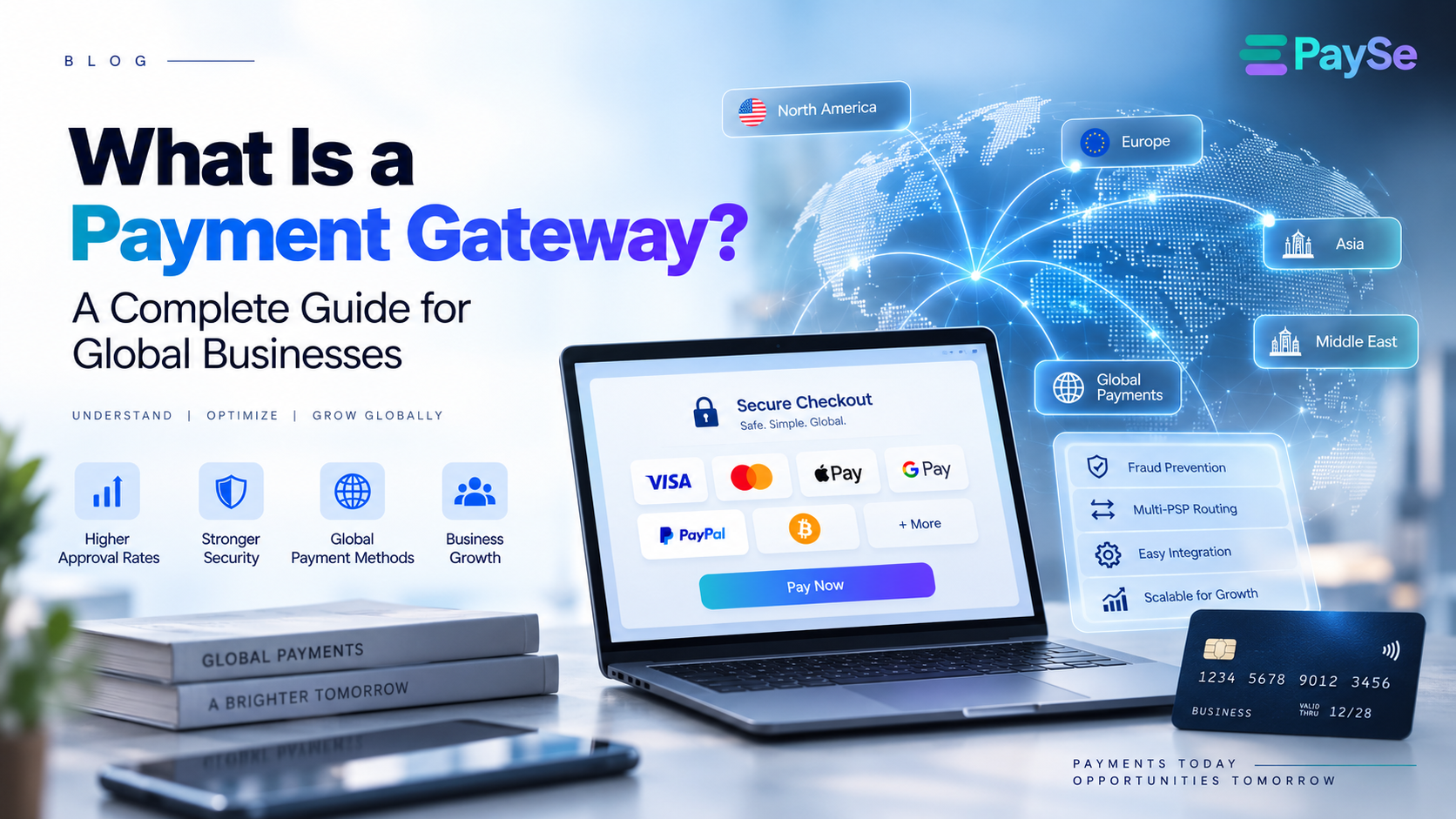
What Is a Payment Gateway? A Complete Guide for Global Businesses
Online payments have become a fundamental part of modern commerce. Whether a business operates an eCommerce store, SaaS platform, travel service, gaming platform, or another digital business, the ability to accept payments securely and efficiently can directly affect revenue.
But what happens after a customer clicks “Pay”?
Behind that simple action is a complex payment infrastructure involving payment gateways, payment processors, acquiring banks, payment methods, fraud prevention systems, and security protocols.
This guide explains what a payment gateway is, how payment gateways work, why they are important for global businesses, and what to consider when choosing a payment gateway provider.
Understanding Online Payment Infrastructure
A payment gateway is a technology that securely connects a customer’s payment method with a merchant’s payment processing infrastructure.
In simple terms, a payment gateway acts as a bridge between:
Customer → Merchant → Payment Processor → Bank/Card Network → Merchant
When a customer makes an online payment, the gateway securely transfers the transaction information to the relevant payment processing infrastructure for authorization.
The customer may only see a checkout page, but several processes can happen in the background within seconds.
A modern payment gateway can support card payments, digital wallets, local payment methods, and other alternative payment methods depending on the provider and market.
How Does a Payment Gateway Work?
Although the process may appear simple to the customer, online payment processing involves several steps.
1. The customer starts a payment
A customer visits a website or application and selects a product or service.
At checkout, they enter their payment information or select an available payment method.
2. Payment information is securely transmitted
The payment gateway securely transmits the transaction data to the payment processing infrastructure.
Security is critical at this stage because sensitive payment information must be protected during transmission.
3. The transaction is processed
The payment infrastructure communicates with the relevant processor, acquirer, or payment network to process the transaction.
Depending on the setup, additional fraud screening or authentication may also take place.
4. The transaction is authorized or declined
The issuing bank or relevant payment institution evaluates the transaction.
The result may be:
- Approved
- Declined
- Requires additional authentication
- Rejected by risk or fraud controls
5. The result is returned to the merchant
The payment gateway sends the transaction result back to the merchant's website or application.
If approved, the business can complete the order.
This entire process can happen within seconds.
Why Is a Payment Gateway Important?
A payment gateway is more than a technical connection for accepting card payments.
For growing businesses, payment infrastructure can influence several important areas of the customer journey.
1. Customer Experience
A complicated or unreliable checkout can cause customers to abandon their purchases.
Customers increasingly expect fast and familiar payment experiences.
Providing relevant payment methods for different markets can reduce friction during checkout.
2. Payment Approval Rates
Not every transaction that reaches a checkout will be successfully completed.
Transactions can fail for many reasons, including:
- Insufficient funds
- Incorrect payment information
- Issuer declines
- Risk controls
- Geographic restrictions
- Technical problems
- Unsupported payment methods
Understanding why transactions fail is an important part of payment optimization.
3. Global Expansion
Selling internationally introduces additional payment challenges.
Different markets may prefer different payment methods, currencies, and transaction flows.
A payment infrastructure designed for international commerce can help businesses manage these differences more effectively.
4. Security
Online payment systems need strong security controls to protect merchants and customers.
Depending on the provider, payment security may include technologies such as:
- TLS encryption
- 3D Secure
- Fraud detection
- Transaction monitoring
- Authentication
- Risk management
- Secure API communication
Security should always be evaluated alongside usability and payment performance.
Payment Gateway vs. Payment Processor: What's the Difference?
These terms are often used interchangeably, but they are not exactly the same.
A payment gateway primarily facilitates the secure transmission and communication of payment information between the merchant and payment processing infrastructure.
A payment processor handles the processing and communication required to authorize transactions between merchants, banks, and payment networks.
In modern payment ecosystems, these functions can be integrated into a broader payment platform.
For merchants, the most important consideration is often not the terminology but whether the provider can deliver:
Reliable processing + strong security + suitable payment methods + efficient transaction routing.
What Is a Multi-PSP Payment Gateway?
Traditional payment setups may rely heavily on a single payment provider.
This can create challenges when that provider experiences:
- Transaction declines
- Technical downtime
- Geographic limitations
- Risk restrictions
- Processing limitations
- Limited payment method coverage
A multi-PSP payment gateway connects a merchant with multiple payment service providers or processing routes.
Instead of relying on a single route, transactions can potentially be routed through different providers based on predefined rules.
For example:
Customer → Payment Gateway → PSP A
If a different route is more appropriate:
Customer → Payment Gateway → PSP B
This approach can provide businesses with greater flexibility and resilience.
For international and high-volume merchants, intelligent payment routing can become an important part of payment optimization.
What Is a High-Risk Payment Gateway?
Some industries are considered higher risk by financial institutions and payment providers because of factors such as:
- Higher chargeback exposure
- Regulatory complexity
- Fraud risk
- International transactions
- Business-model characteristics
- Reputation or compliance considerations
Examples may include certain businesses in:
- Gaming and iGaming
- Travel and OTA
- Crypto and Web3
- Nutraceuticals
- Adult entertainment
- Certain eCommerce models
For these businesses, finding a suitable payment provider can be more challenging than for traditional merchants.
A high-risk payment gateway is designed to support businesses that require more specialized payment infrastructure, risk management, and processing solutions.
However, being classified as high-risk does not mean that a business should compromise on security or compliance.
A professional payment setup should still prioritize appropriate KYB/KYC procedures, transaction monitoring, fraud prevention, and applicable regulations.
How to Choose the Right Payment Gateway
Choosing a payment gateway should not be based on transaction fees alone.
Businesses should evaluate the entire payment infrastructure.
1. Supported Payment Methods
Consider whether the provider supports the payment methods your customers actually use.
Depending on your target markets, this may include:
- Visa
- Mastercard
- American Express
- Apple Pay
- Google Pay
- Local payment methods
- Bank transfers
- Digital wallets
The right payment methods can vary significantly between markets.
2. Geographic Coverage
If you operate internationally, check which countries and currencies the provider supports.
A gateway that works well in one market may not necessarily be the best solution for another.
3. Approval and Decline Management
Look beyond the headline processing fee.
Understand how the provider handles transaction declines, routing, retries, and alternative processing routes.
4. Fraud Prevention
Fraud protection should be part of the payment strategy from the beginning.
Look for appropriate controls such as:
- 3D Secure
- Rule-based fraud prevention
- Transaction monitoring
- Risk scoring
- Velocity controls
- Authentication
5. API and Integration
Developers should evaluate the quality of the payment API and integration process.
A good payment integration should be:
- Well documented
- Secure
- Reliable
- Easy to test
- Suitable for the merchant's technical architecture
6. Scalability
Your payment infrastructure should be able to grow with your business.
Consider:
- Transaction volume
- New markets
- Additional currencies
- Additional payment methods
- Multiple processing providers
A payment gateway should not become a bottleneck as the business scales.
Payment Gateway Fees: What Should Businesses Expect?
Payment gateway pricing can vary significantly depending on the provider and merchant.
Common pricing models may include:
- Percentage-based transaction fees
- Fixed transaction fees
- Monthly platform fees
- Setup or integration fees
- Chargeback fees
- Currency conversion fees
However, the lowest advertised processing fee is not always the lowest overall cost.
A business should evaluate total payment performance, including successful transactions, failed payments, chargebacks, conversion rates, and operational costs.
For example, saving a small amount on processing fees may not be beneficial if a business experiences significantly more failed transactions.
The goal should be efficient payment processing, not simply the lowest fee.
Common Payment Gateway Problems Businesses Face
Even businesses with a functioning payment gateway can encounter payment challenges.
Some of the most common include:
Payment Declines
A transaction may be declined even when the customer is legitimate and willing to purchase.
Understanding the reason behind declines is essential for improving payment performance.
Limited Payment Methods
If customers cannot use their preferred payment method, they may abandon checkout.
Cross-Border Payment Issues
International transactions can introduce additional complexity involving currencies, issuers, regulations, and risk controls.
Chargebacks
Chargebacks can increase operational costs and create additional risk for merchants.
Businesses need appropriate monitoring and dispute-management processes.
Poor Checkout Experience
Slow loading times, complicated forms, unnecessary authentication steps, or unclear payment flows can negatively affect conversion.
The Future of Payment Infrastructure
The global payment ecosystem continues to evolve.
Customers expect payments to become faster, simpler, and more flexible.
At the same time, businesses need payment infrastructure that can manage increasing complexity across markets, payment methods, risk requirements, and processing providers.
This is why modern payment strategies are increasingly moving beyond the traditional concept of simply “accepting payments.”
The focus is shifting toward:
Payment optimization → intelligent routing → risk management → higher resilience → better customer experience.
For businesses operating internationally, payment infrastructure can become a strategic part of growth rather than simply a technical requirement.
How EPaySe Approaches Global Payment Processing
EPaySe is built around the idea that businesses should have more flexibility in how their online payments are processed.
Its payment infrastructure focuses on areas including multi-PSP routing, high-risk payment processing, fraud prevention, global payment acceptance, and payment infrastructure designed for growing businesses.
For merchants operating across different markets or industries with more complex payment requirements, having flexible processing infrastructure can help create a more resilient payment strategy.
The right solution ultimately depends on the merchant's business model, target markets, transaction profile, risk level, and technical requirements.
Final Thoughts
A payment gateway is not simply a tool for accepting credit cards.
It is an important component of the infrastructure connecting your customers, business, payment providers, banks, and global payment networks.
For businesses operating internationally, choosing the right payment gateway can influence:
- Payment approval rates
- Customer experience
- Checkout conversion
- Security
- Fraud management
- Global expansion
- Payment resilience
As online commerce becomes increasingly global, businesses need to think beyond “Can I accept payments?”
The better question is:
“Can my payment infrastructure support my business as it grows?”
Related Articles
What Is a Rolling Reserve? How Held Funds Work for Merchants
A rolling reserve is a share of a merchant's sales that a payment provider may hold back and release later. See how it works and what to check in your terms.
Payment Gateway vs Processor vs Acquirer: Who Does What
A payment gateway, a processor and an acquirer each handle a different step of a card payment. See who does what, in plain words, and why the roles are sometimes bundled.

How a Card Payment Moves: Checkout to Settlement
A card payment moves from checkout through a gateway and card network to the issuing bank, which approves or declines it. Funds settle to the merchant later.